
Settings » General Settings » Integrations Tab
Link: https://support.brilliantdirectories.com/support/solutions/articles/12000050980
The Integrations tab of the General Settings page holds the keys and switches that connect the website to outside services: spam protection lists, Google reCAPTCHA, Google Maps, Google Analytics, ChatGPT, Google and Facebook login, SendGrid and affiliate tracking.
Open it from Settings » General Settings, then click the Integrations tab. Each integration is a section, listed in the side menu; click one to jump to it. Some sections show only when their add-on is active, so the list can be shorter on some websites. The layout of the page and how changes are saved are explained in Settings » General Settings Tab.
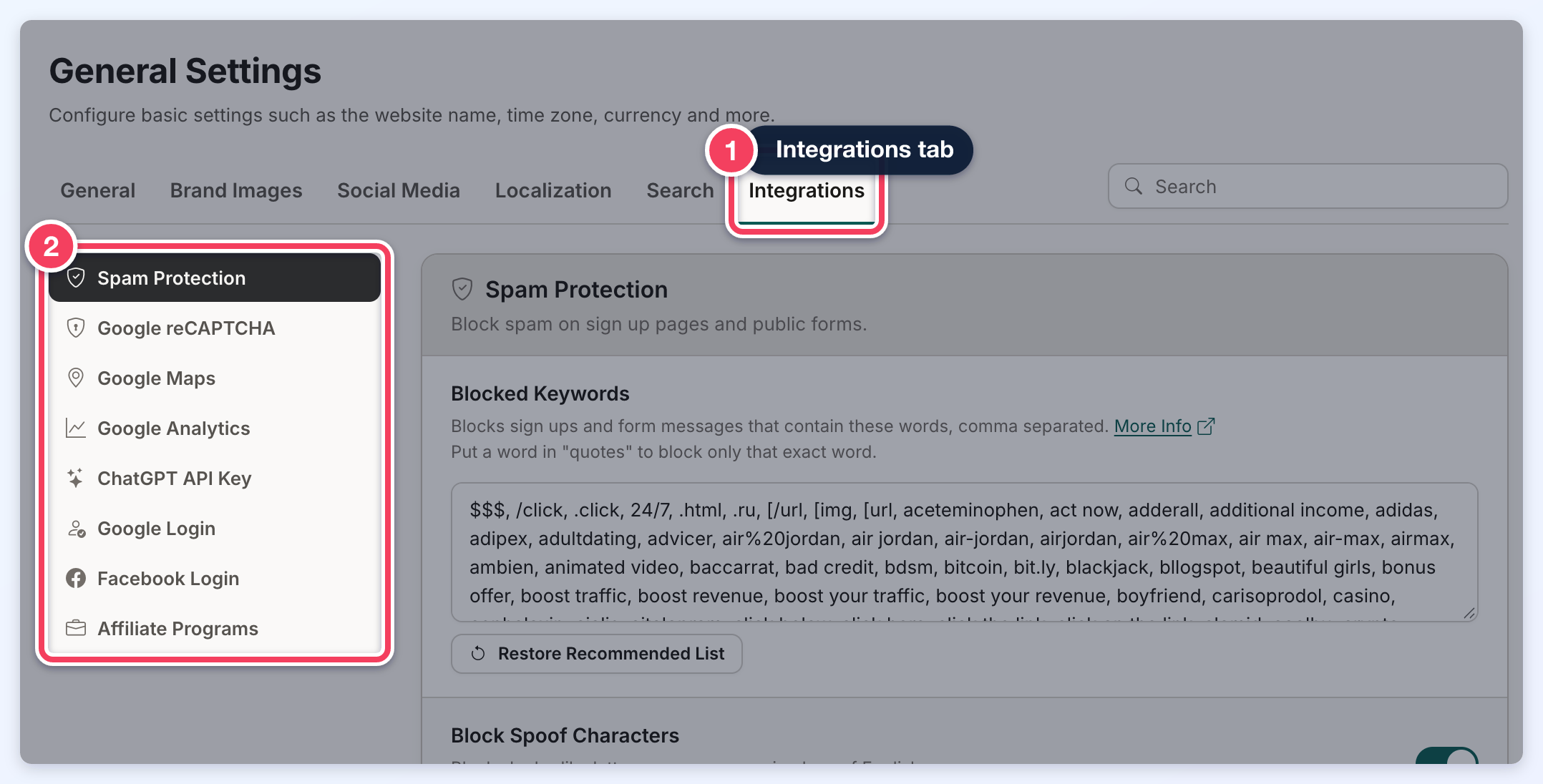
After a change, a bar with Discard and Save appears at the top of the page. Click Save to keep the changes.
Before Starting: Connect a Live Domain
Most of these services check the website's domain, so a live domain needs to be connected before setting them up. While the website still uses its directoryup.com address, the tab opens on Connect a Live Domain First, with two buttons: Connect Live Domain opens the Domain Manager, and View Integration Settings shows the settings below.
New websites on a directoryup.com address come with test credentials for reCAPTCHA and Google Maps already active. Those stop working once the website moves to a real domain, and new credentials need to be added here. More details: directoryup.com Subdomain Test Credentials and Guide 1. How to Connect a Live Domain Name.
Spam Protection
Blocks spam on sign up pages and public forms. More details: Spam Form Protector Add-On.
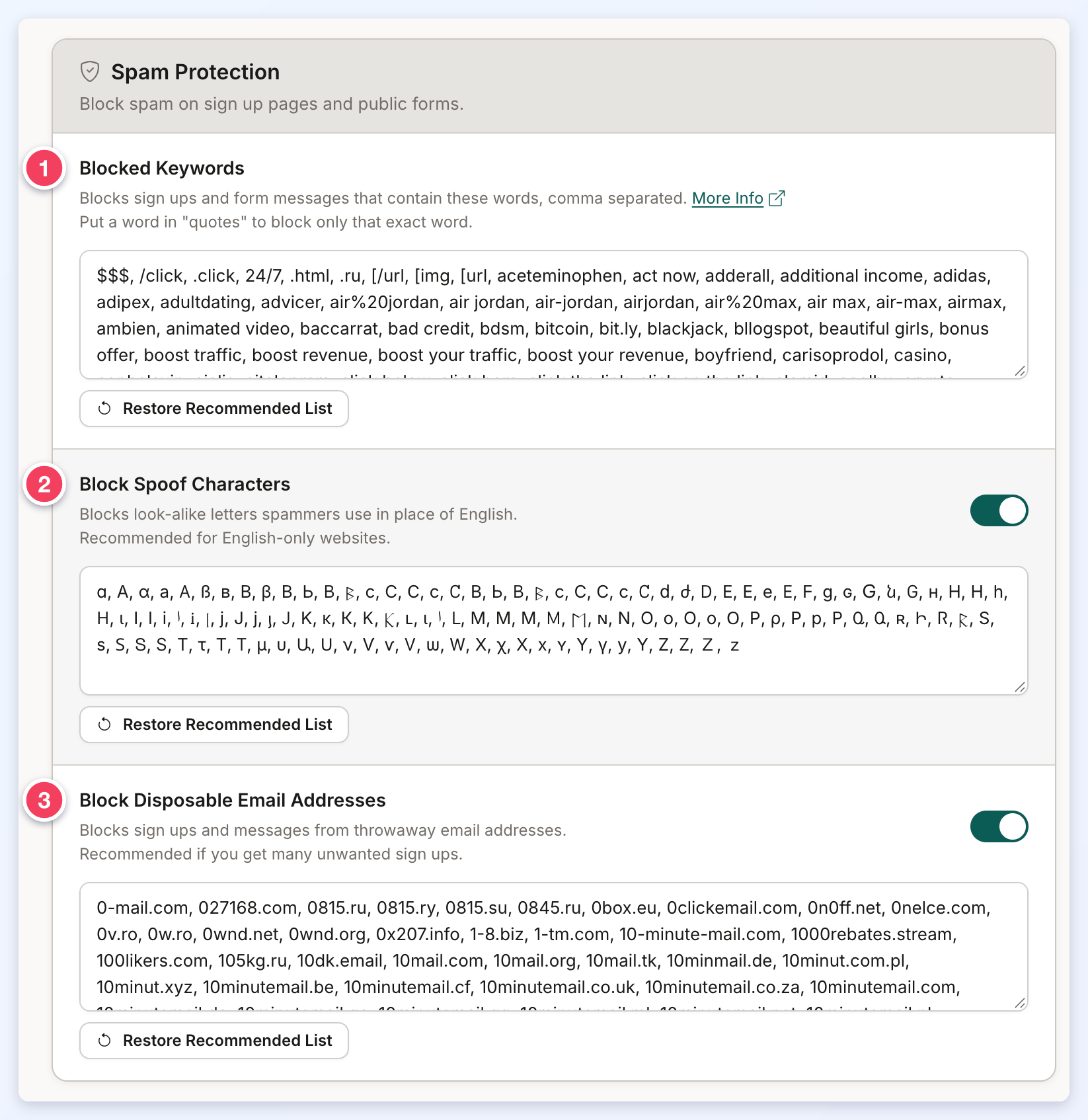
- Blocked Keywords: a comma separated list of words. Sign ups and form messages that contain any of them are blocked. Put a word in "quotes" to block only that exact word, rather than any word containing it.
- Block Spoof Characters: blocks look-alike letters that spammers use in place of English letters. Recommended for English-only websites. Turn on the switch at the right to use it; the list of characters then shows under it and can be edited.
- Block Disposable Email Addresses: blocks sign ups and messages from throwaway email addresses. Recommended when a website gets many unwanted sign ups. Turn on the switch at the right to use it; the list of blocked email domains then shows under it and can be edited.
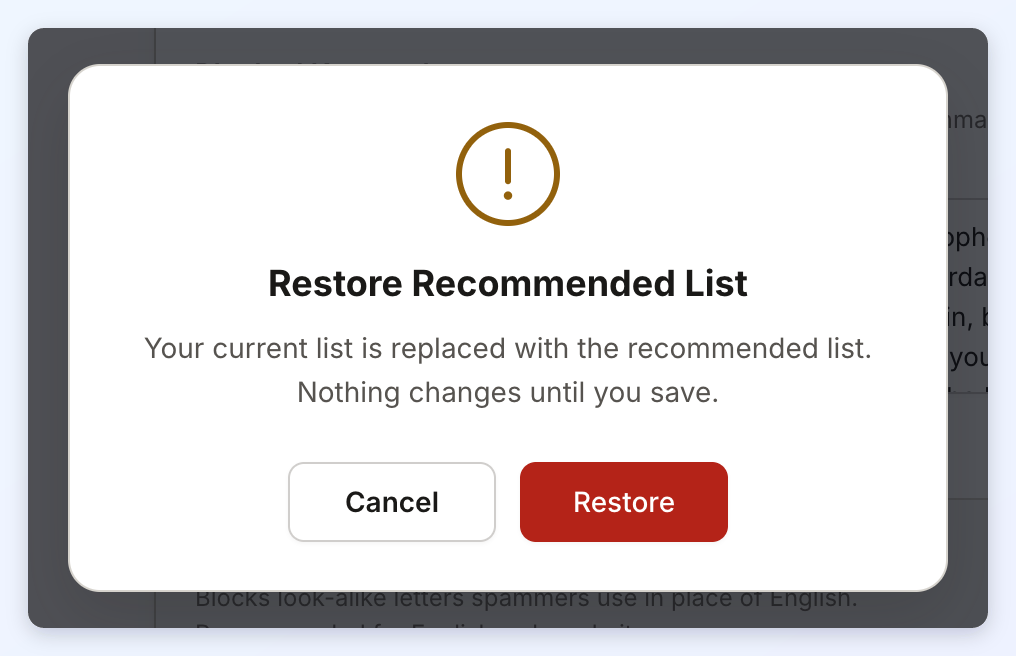
Each of the three lists has a Restore Recommended List button. It asks first: the dialog explains that the current list is replaced with the recommended list, and that nothing changes until the settings are saved. Click Restore to put the recommended list in the box, then Save, or click Cancel to keep the current list.
Google reCAPTCHA and Google Maps
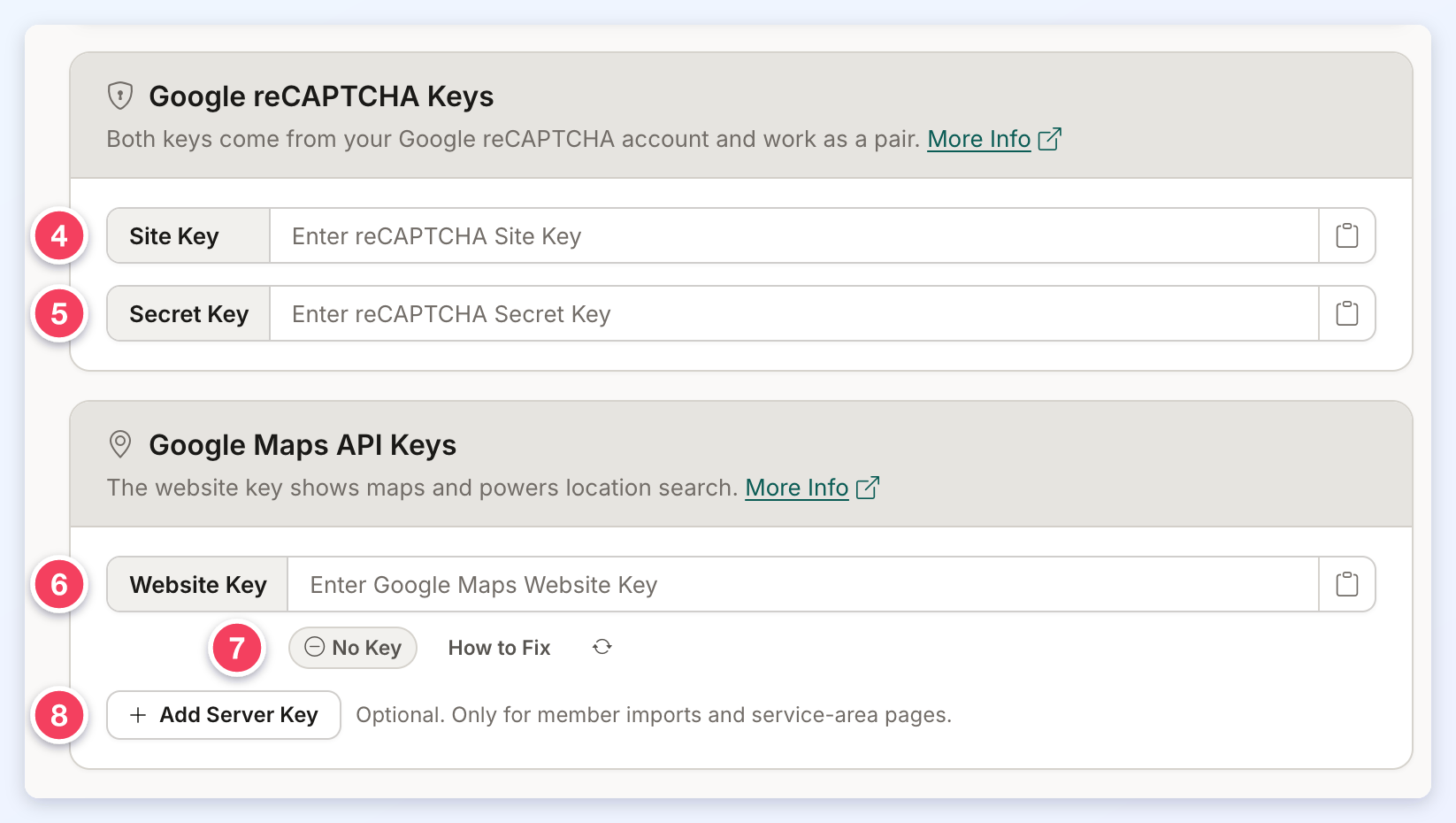
- Site Key (Google reCAPTCHA Keys): the reCAPTCHA site key. Both reCAPTCHA keys come from the same Google reCAPTCHA account and work as a pair. More details: Guide 8. How to Enable Form Security with Google reCaptcha.
- Secret Key (Google reCAPTCHA Keys): the reCAPTCHA secret key that pairs with the site key.
- Website Key (Google Maps API Keys): the Google Maps key that shows maps and powers location search on the website. More details: Guide 9. How to Enable Maps with Google Maps API.
- Key status: the website key is tested automatically, and the result shows under the field, EG No Key, Not a Maps Key, Working, Needs Attention or Not Working. A newly typed key that can only be tested from the website itself shows Save to Test. Hover over the status for Google's full result, click How to Fix for the steps that fix the problem, or click the circular arrows to test again.
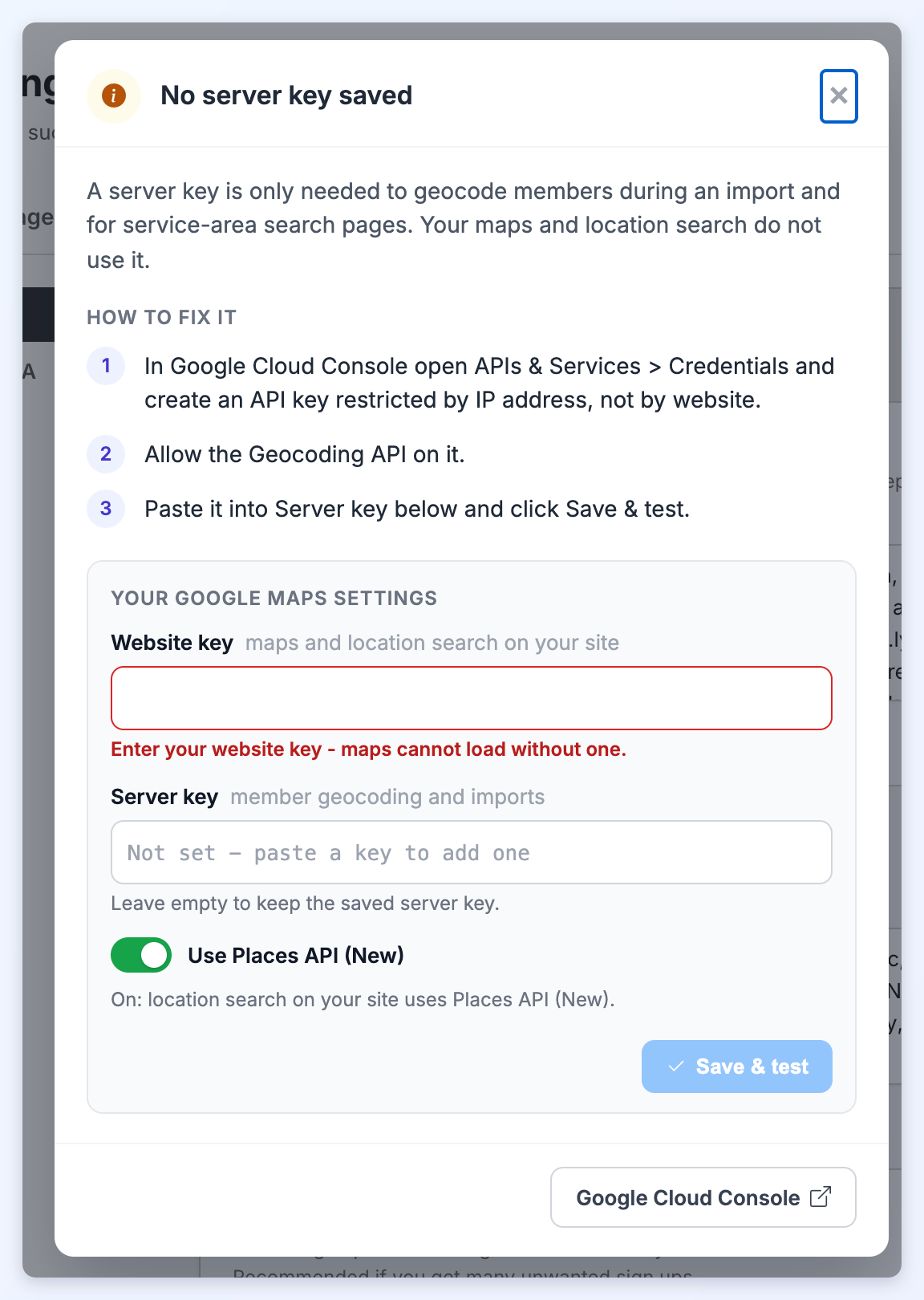
- Add Server Key: an optional second Google Maps key, needed only to geocode members during an import and for service-area search pages. The website's maps and location search do not use it. The button opens a window with the steps to create the key in Google Cloud Console (restricted by IP address, not by website, with the Geocoding API allowed), a Server key field, and Save & test, which tests the key before saving it. Once saved, the server key shows as Server Key with only its last four characters (Saved key ending in), its own status, and a pencil button to change it.
Google Analytics and ChatGPT
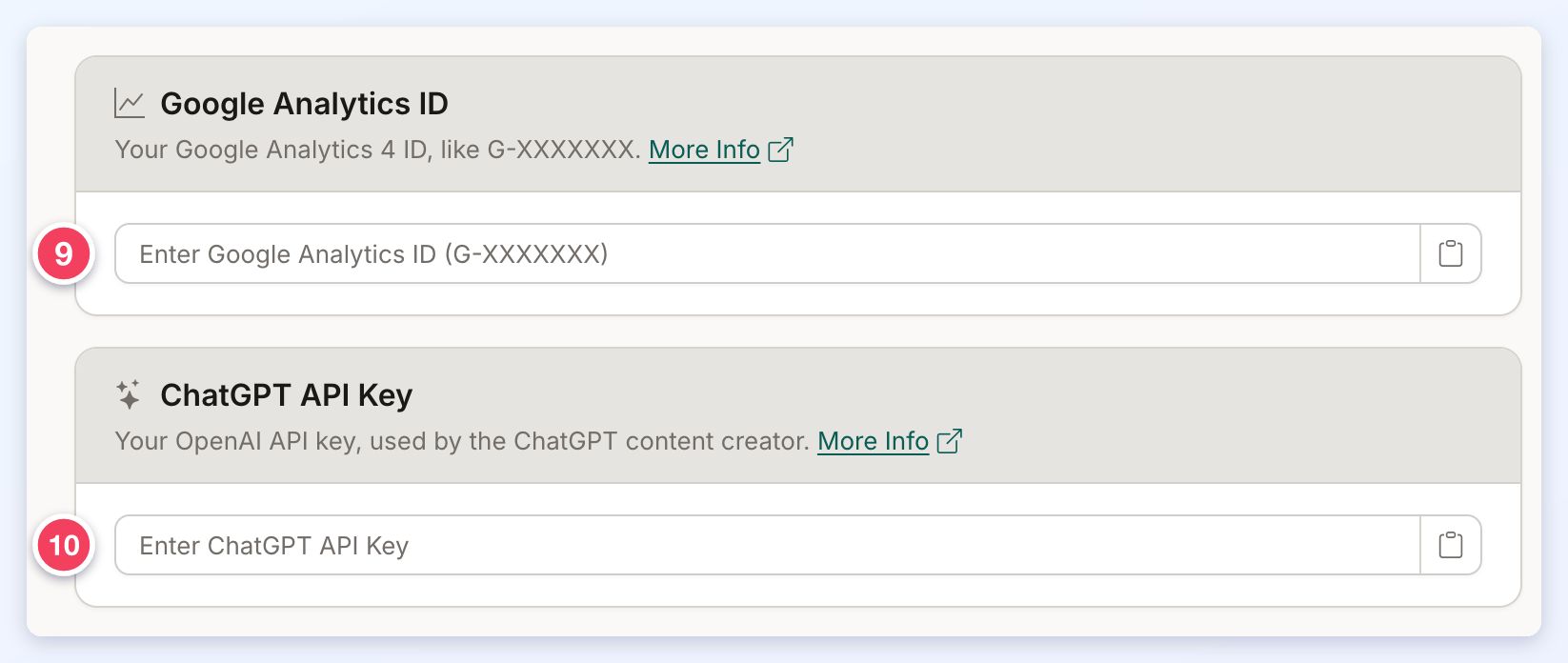
- Google Analytics ID: the website's Google Analytics 4 ID, in the format G-XXXXXXX. An ID that does not start with G- is refused with the message Invalid Google Analytics ID. If Google Analytics code is already on the website (EG pasted into the Design Settings or a widget), a GA4 Code Already Found message lists where, since adding the ID too can count visits twice: click Yes, Continue to keep the ID or No, Cancel to clear it. More details: Installing Google Analytics Tracking Code (easy method).
- ChatGPT API Key: the OpenAI API key used by the ChatGPT content creator. This section shows only when the ChatGPT add-on is active. More details: ChatGPT Content Creator.
Google and Facebook Login
These sections let members log in with their Google or Facebook account. Each shows only when its add-on is active. Login with Google or Facebook also has to be turned on for each membership plan, through the Membership Plans link in the section.
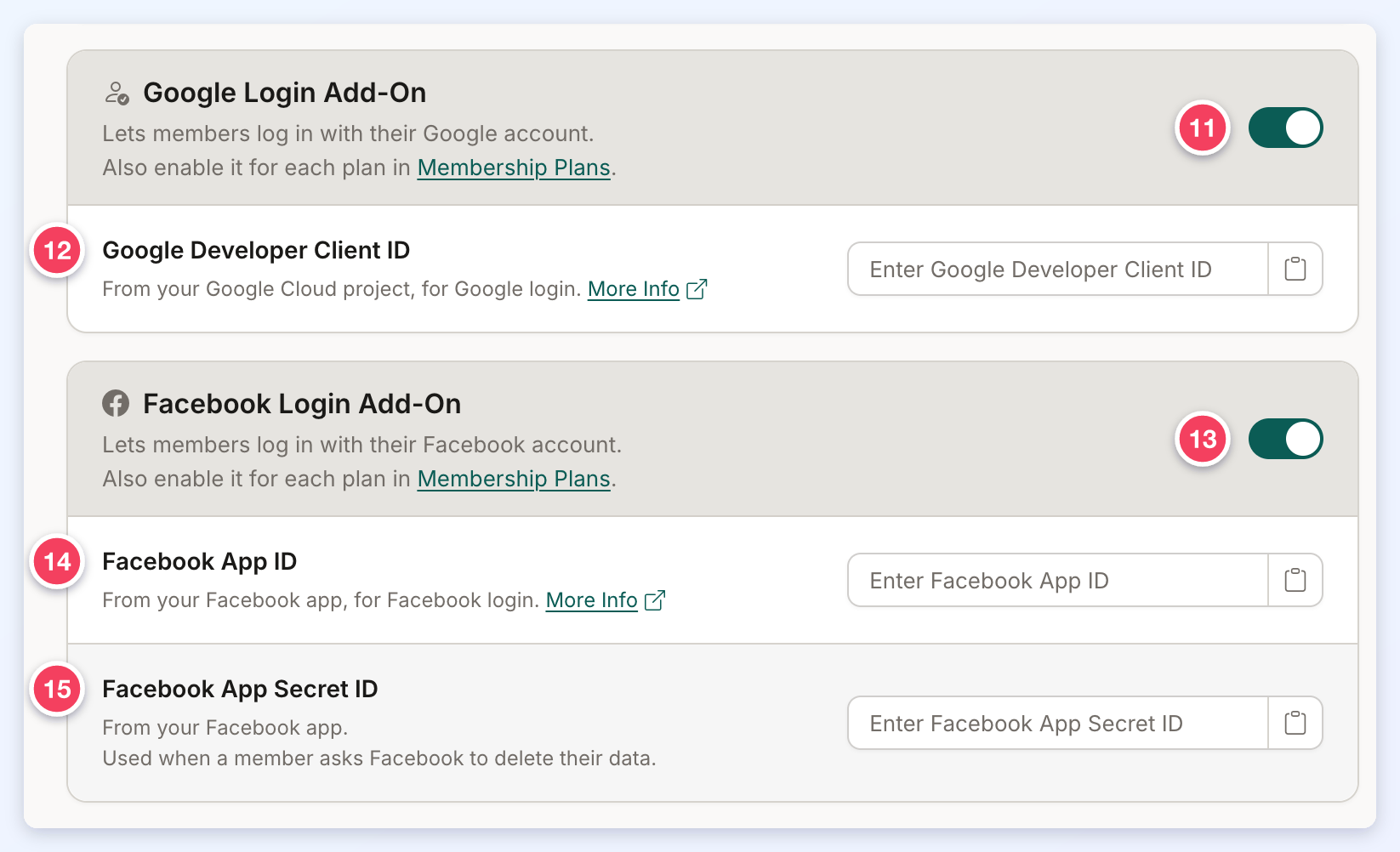
- Google Login Add-On switch: the switch at the right of the section title turns Google login on or off for the website.
- Google Developer Client ID: the client ID from the website's Google Cloud project, used for Google login. More details: Google Login Add-On.
- Facebook Login Add-On switch: the switch at the right of the section title turns Facebook login on or off for the website.
- Facebook App ID: the ID of the website's Facebook app, used for Facebook login. More details: Facebook Login Add-On.
- Facebook App Secret ID: the secret of the same Facebook app. It is used when a member asks Facebook to delete their data.
Email Delivery (SendGrid)
This section shows only on websites already connected to their own SendGrid account. It holds the connection method (How Do You Want to Connect to SendGrid?), the credentials, and a Test Connection to SendGrid button that checks them before saving.
Affiliate Programs
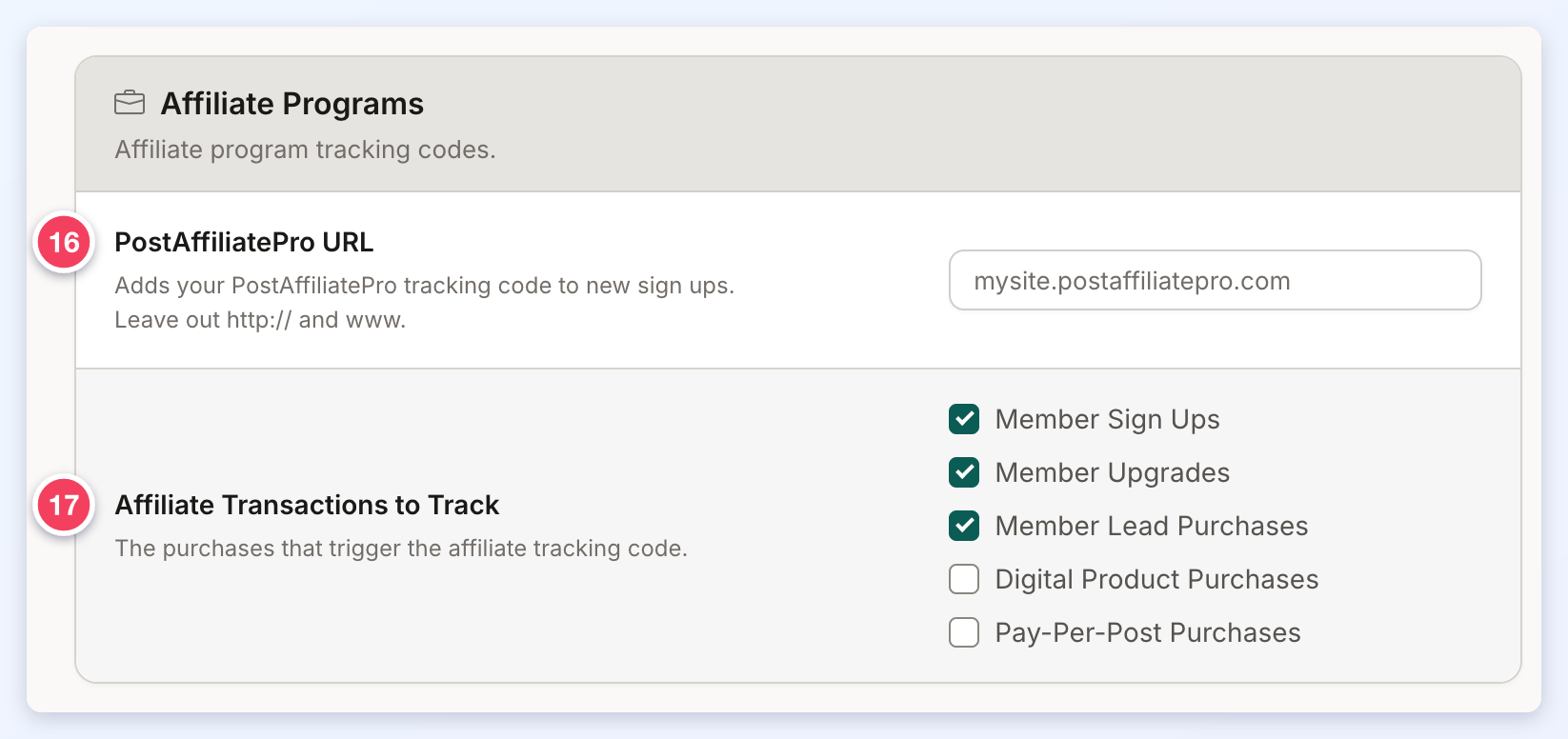
- PostAffiliatePro URL: adds the PostAffiliatePro tracking code to new sign ups. Enter the address without http:// and www, EG mysite.postaffiliatepro.com.
- Affiliate Transactions to Track: the purchases that trigger the affiliate tracking code: Member Sign Ups, Member Upgrades and Member Lead Purchases, plus Digital Product Purchases and Pay-Per-Post Purchases when those add-ons are active. More details: Affiliate Program Integrations.
Private Member Chat Settings
The private chat settings that used to be on this tab are now under Interactions » Private Chats: click Chat Settings at the top of that page. More details: Private Member Chat.
